Glass Packaging

"This post is a summary version of the article below, for more details see the attached file."

1. Background for Glass Packaging

  • Glass is 100% recyclable and can be reused infinitely without quality loss.
  • Advantages: strong, durable, chemically inert, impermeable to gas/water, ideal for long-term storage.
  • Disadvantages: brittle, heavy, sensitive to thermal shock, possible ion leaching (important for pharmaceuticals).
  • Types of pharmaceutical glass:
    • Type I (borosilicate): most durable, but costly.
    • Type II (soda lime sulphated): reduced alkali solubility, hazy appearance.
    • Type III (soda lime standard): lower standard, still widely used.

2. Raw Material

  • Main ingredients: silica sand, soda ash, limestone/dolomite, alumina, colorants.
  • Cullet (recycled glass) 30–50% helps save energy and cost.
  • Functions:
    • Silica: base material.
    • Soda: lowers melting point.
    • Calcium: increases hardness & chemical durability.
    • Alumina/Boron: improves strength, thermal shock resistance.
    • Decolorizers & colorants: adjust clarity and produce colors (flint, amber, green, blue, red, opal).

3. Container Design & Tolerance

  • Cylindrical, rounded shapes are common for easier forming, strength, and high-speed filling.
  • By product type:
    • Carbonated drinks: cylindrical, curved bottles to withstand pressure.
    • Semi-solids (paste): wide-mouth jars.
    • Granules/powder: wide jars with airtight seals.
  • Key parts: finish, neck, shoulder, sidewall, heel, base.
  • Tolerance examples: volume, diameter, height, verticality – controlled by standards.
  • Decoration: stippling, frosting, screen printing, labeling.

4. Manufacturing Process

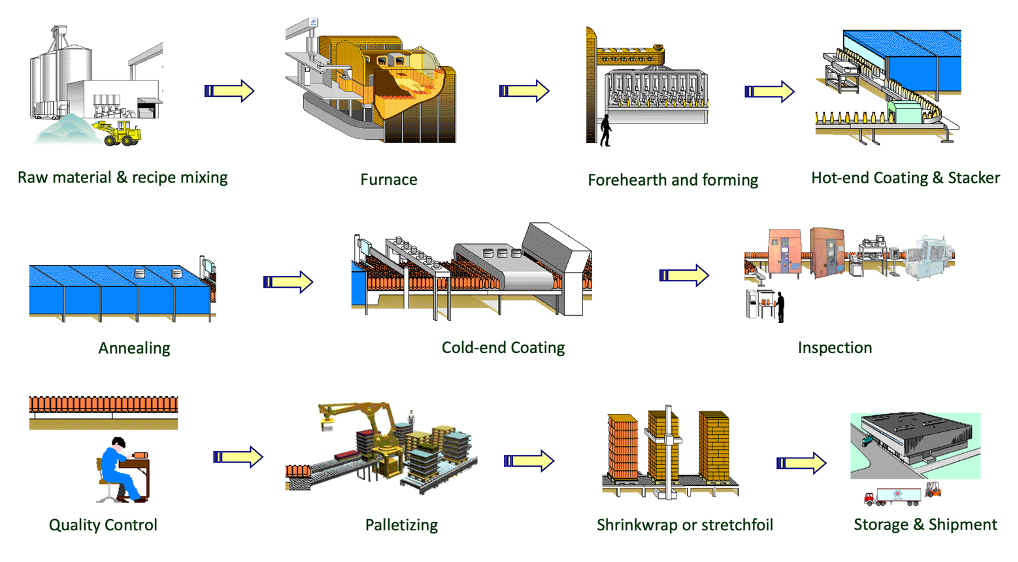
  • Steps:
    1. Cullet collection & treatment.
    2. Raw material batching.
    3. Furnace melting (1,350–1,600°C).
    4. Molten gobs cut & fed into molds.
    5. Forming methods:
      • Blow & Blow (narrow-neck bottles).
      • Press & Blow (wide-mouth jars).
      • NNPB (narrow neck press & blow – lighter bottles).
    6. Surface treatment (hot & cold coatings).
    7. Annealing (stress relief in lehr).
    8. Inspection & sorting.

5. Quality Control

  • Covers: mold maintenance, raw material analysis, density, color, thickness, pressure/impact resistance, coating, thermal shock.
  • Common defects: blisters, cracks, deformation, inclusions, thin walls, dirt, seams, scratches, etc.
  • Defects affect safety, usability, aesthetics, labeling, and packaging efficiency.

6. Printing & Labelling

  • Screen printing: sustainable (no label waste), durable, but lower resolution and hard to change artwork.
  • Jet printing: higher resolution, flexible for quick content changes.
  • Labelling (most common): paper/plastic/metal labels, easy to change design, compatible with auto labelling machines (hundreds → tens of thousands units/hour).
  • Label styles: wrap-around, front & back, shrink sleeve.

Leave a comment

Design a site like this with WordPress.com
Get started